
MDBs: their privileges and constraints, and innovative ways they use to reduce risk, free up incremental lending capacity and raise new equity capital. The health sector seems to benefit less than other sectors from released lending capacity: we ask why and explore new and scalable approaches.
This is Part 2B of the P4H series on financing health systems in the age of the aid retreat. Part 2 comprises three posts – 2A, 2B, and 2C. In Part 2A we show how Africa’s institutional capital would be hard to mobilise for investing in health. Here, we discuss MDBs: their privileges and constraints and review innovative ways MDBs use to reduce risk and free up incremental lending.
MDBs: The tip of the spear
When it comes to volume, multilateral (and increasingly public development) banks (MDBs and Public Development Banks – PDBs) are the tip of the spear: the only actors with balance sheets deep enough, between them, to move the needle. They are also uniquely positioned on several other counts and in relation to the most movable institutional capital (insurance and pension funds) we looked at in From billions to balance sheets: where will the money for health actually (not) come from – Part 2A.
MDBs, to name but a few of their advantages, have the necessary:
- Reach: MDBs exist to move shareholder capital across borders to the countries with the greatest need, and already lend at scale into risky developing-country markets
- Mandate: an MDB’s capital is put up by donor governments expressly to bear development risk, and their shareholders have explicitly directed them to do more under clear developmental and poverty-reduction mandates
- Independence: no repression, no crowding out: because MDB capital is not workers’ deferred wages or policyholders’ claims, deploying it carries no risk of financial repression eroding savings and pensions, or crowding out scarce government money.
- Liquidity: unlike a pension or insurance fund, an MDB issues long-term bonds and holds its loans to maturity, so it can comfortably carry illiquid, long-dated infrastructure that those funds cannot.
- Capability: MDBs hold the in-country origination, appraisal, approval and supervision apparatus, built over decades, that pension funds, insurers and Sovereign Wealth Funds (SWFs) lack and would take years to replicate.
Funding vs Capital Constraints
Unlike commercial banks who must strictly answer to government regulators (like the Federal Reserve or the European Central Bank), MDBs are treaty-based international organizations. They have no banking regulator and do not answer to Basel rules. The only “regulators” the World Bank, African Development Bank (AfDB), or Inter-American Development Bank (IDB) truly have are Credit Rating Agencies. If an MDB loses its AAA rating, its entire business model collapses because its cost of market borrowing would skyrocket.
In addition, MDB-issued bonds qualify for a 0% risk weight under the Basel framework and, thanks to their AAA rating and high liquidity, trade at a tiny spread over other high-grade sovereign assets such as US Treasuries. This means banks can hold them capital-free while central banks and sovereign-wealth funds treat them as prime reserve assets and translates into MDBs being able to place as many billions as they are willing to issue.
So, to grow their book of business, in general, raising new funding is not a binding constraint for MDBs. The primary binding constraint is maintaining their AAA rating from the rating agencies and staying in compliance with their own Internal Capital Adequacy Frameworks (ICAFs).
Both the Credit Rating Agency (CRA) and ICAF regimes rest on the same basis: each measures the ratio of the MDB’s (usable) equity capital to its risk-(weighted) assets, so any tool that reduces the risk on the loan book expands lending headroom. Where they differ is how much credit these regimes assign those risk-reduction tools.

Under an MDB’s ICAF, a synthetically insured or guaranteed loan can be assigned a 0% or near-0% risk weight, on the reasoning that a loss arises only if the borrower and the highly-rated protection provider fail together (highly unlikely). That radically reduces the modelled risk-weighted assets and, with equity unchanged, mechanically lifts the ratio, enabling fresh lending with no new equity. The rating agencies recognise the same transfer of risk more conservatively: rather than writing the risk to zero, they substitute the provider’s rating for the borrower’s and adjusting downwards for counterparty concentration, tenor and basis risk, hence offering substantial but partial relief, in practice freeing perhaps 50% to 65% of the capital tied to those loans.
Because it is the agency view that underpins the AAA rating, the rating agencies and their methodologies are a critical determinant of an MDB’s capacity to grow.
Preferred Creditor Status
Another important MDB superpower is the Preferred Creditor Status (PCS) and related treatment. PCS is the customary, albeit not legally codified, expectation that sovereign borrowers will repay multilateral development banks ahead of other creditors, and will keep servicing MDB loans even while defaulting on, or restructuring, commercial and bilateral debt. This convention rests on mutual self-interest: countries protect their standing with the MDBs because these institutions are a reliable source of low-cost, counter-cyclical finance especially in crises, so defaulting would jeopardise future access.
The practical effect is that MDBs experience far lower losses on sovereign lending than their borrowers’ standalone credit ratings would predict with exceptionally strong historical default and recovery experience. Rating agencies and the MDBs’ own capital frameworks reward this as PCS supports the AAA rating and lowers the effective risk on sovereign exposures. It is, in essence, the foundational feature underpinning MDBs’ cheap funding and lending capacity.
What can MDBs do to expand their lending capacity?
Based on the above, MDBs have two avenues for increasing their lending capacity: we deal with reducing risk first and then (2C) with raising new equity capital.
REDUCING RISK: SHRINKING THE DENOMINATOR
Securitisation: cash and synthetic
The most direct route to freeing headroom for new lending by the MDB’s/PDB’s is to securitise existing loans. Securitisation means offloading a pool of existing MDB loans and using it to free up capital and/or raise new money, so the bank can lend again without waiting for the originals to be repaid. In a cash (true-sale) securitisation, the loans are actually sold off the balance sheet to investors, bringing in genuinely new funding. In a synthetic securitisation the loans stay put and only their credit risk is transferred (via guarantees or credit default swaps), which frees up lending headroom.
In recent years, MDB shareholders have strongly signaled the direction of travel: the G20 Capital Adequacy Frameworks (CAF) Review’s Recommendation 3 on financial innovation is an instruction to MDBs to leverage their balance sheet harder. None of this is theoretical any longer: since 2018, the African Development Bank, IDB Invest and, most recently, IFC have all taken securitisation transactions to market, and the West African Development Bank has gone further still. The ambition now is scale, and ideally across different MDBs and PDBs.
Based on the limited but growing list of deals, a pattern is emerging: securitisation has mostly (exclusively in the case of World Bank (WB) with International Finance Corporation (IFC) only) targeted private (non-sovereign) capital, though exceptions are emerging amongst regional MDBs which have been testing the water on their public loans with synthetic securitisations and in, one case, a cash securitisation too. The distinction matters as non-sovereign (private-sector) loans behave like ordinary commercial credit, whereas sovereign loans to governments are shielded by preferred creditor status (PCS) for the banks, which however they cannot pass on to a private buyer or a Special Purpose Vehicle (SPV) (hence the preference) for synthetic securitisation (see Figure 1).
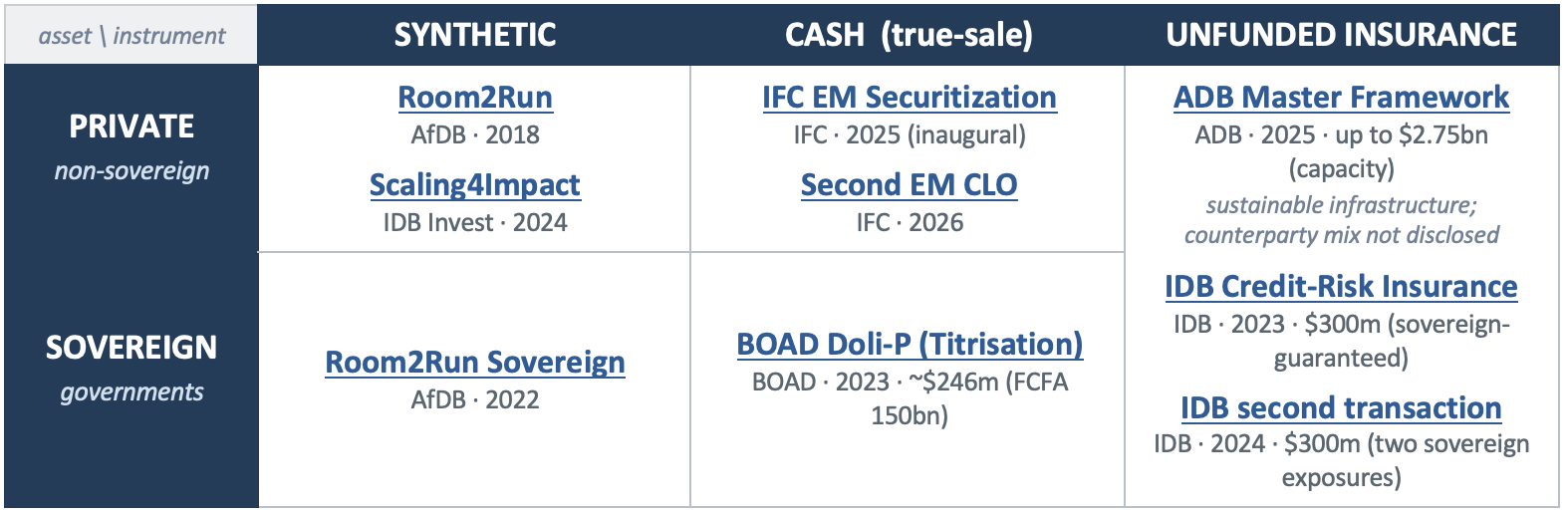
Deal names link to primary sources. BOAD Doli-P raised cash while retaining the loans (funded hybrid). ADB’s $2.75bn is maximum insured capacity under a framework agreement, not capital raised or mobilised. The unfunded-insurance column is not split by row: ADB’s framework is defined by asset class; asset mix between sovereign and non-sovereign is not disclosed.
Private Credit Insurance: transferring risk to an insurer’s balance sheet
Securitisation requires structuring, an SPV and an investor base. There is a simpler route to the same net effect through buying unfunded credit insurance on a slice of the existing loan book where the bank pays a premium and makes claims on the insurer if the borrower fails to pay. For capital purposes the exposure is treated as though owed by a highly-rated insurer rather than by the borrowing sovereign or project, so risk-weighted assets fall and headroom is created.
The IDB piloted this in December 2023 with $300 million of cover across fourteen insurers and has since returned for a second $300 million transaction on two sovereign exposures with seven insurers. This puts the lending multiplier on released capital at x3-4 framing both deals as CAF Review implementation. ADB has moved from pilot to programme: its May 2025 Master Framework Agreement for Sustainable Infrastructure with ten insurers provides for up to $2.75 billion of cover, with underwriting and approval standardised so that each transfer no longer needs bespoke negotiation. Both banks are now scaling this channel deliberately.
As PCS makes sovereign default rare, the sovereign book is cheap to insure, which is why the IDB has pointed its cover at sovereign exposures, while ADB’s framework is organised around an asset class, sustainable infrastructure, instead. What remains untested is whether a sovereign borrower extends the same forbearance to an exposure it knows sits with a commercial insurer, and whether a paying insurer’s subrogated claim enjoys any preference at all. Furthermore, the protection is unfunded, so the relief depends on the insurer paying under stress. Most relevant for our purposes, insurers underwrite the borrower rather than the asset, so a sovereign loan for a health system is as insurable as one for a road or a grid, and whether the freed capital reaches health is a question of allocation inside the bank rather than of what the market will cover. [1]
Regional MDB Innovation: Exposure Exchange agreements
Because regional MDBs face scale limitations in the form of concentration of risk given their regional focus (e.g. Inter-American Development Bank (IDB) is heavily exposed exclusively to Latin America, and the AfDB is exposed entirely to Africa) they frequently bypass private Wall Street securitisation entirely by trading risk with each other. Such Exposure Exchange Agreements (EEAs) as the $3.2bn one between IDB and AfDB, allow one bank, say AfDB, to buy protection from the other (IDB) on a cluster of African loans, while simultaneously selling protection to the IDB on a cluster of Latin American loans. No loans change hands and no private investors are involved. This synthetic trade instantly diversifies both balance sheets, satisfying rating agencies while perfectly preserving both banks’ PCS.
EEAs have become a standing facility with the four core sovereign-lending MDBs (AfDB, IDB, IBRD and, joining more recently, ADB) operating under a common MDB Exposure Exchange Master Agreement, under which numerous exchanges have been executed since the framework was first approved by their boards in 2015.
Bilateral (Donor) Portfolio Guarantees
A regional MDB can obtain relief on a subset of its sovereign loans by having a highly-rated non-borrowing shareholder guarantee part of the portfolio, allowing the bank to replace the borrowing sovereigns’ risk weighting with the guarantor’s AAA weighting.
The clearest example is the African Development Bank’s Room to Run Sovereign (R2RS), pledged at COP26 in Glasgow in 2021, signed in May 2022 and closed in October 2022. The UK government (through the FCDO) and a group of London-market insurers together provided $2 billion of cover on a subset of the AfDB’s sovereign loan portfolio. The loans remain on the AfDB’s balance sheet and continue to be administered by the bank; only the credit risk is partially transferred. Because a highly-rated sovereign now stands behind the exposure, rating agencies recognise the relief, freeing headroom for up to $2 billion of new lending (here earmarked for climate finance). It keeps the assets on balance sheet and, by using an official guarantor rather than purely private insurance, sidesteps some of the counterparty and pricing questions of market cover, though at the cost of relying on finite donor guarantee capacity.
Similarly, in late 2025, IDB signed a $200 million guarantee agreement with Nordic partners—Impact Fund Denmark, Norway’s Norad, and Sweden’s Sida, that gave IDB approximately $800 million in expanded lending capacity which was, again, earmarked for fresh climate finance and renewable investments.
The World Bank Group has moved in both directions at once. Its 2024 consolidation of guarantee business into a single MIGA-run platform to make guarantees is outward-facing: it de-risks investors and lenders, not the Bank’s own balance sheet. The more relevant innovation for our purposes runs the other way. The twenty-first replenishment of the International Development Association (IDA21) introduced a Portfolio Guarantee Platform (PGP) allowing highly rated donors to guarantee IDA’s lending book with no upfront cash. The Report from the Executive Directors describes it as a contribution modality that reduces credit risk on IDA’s balance sheet and thereby increases IDA’s lending capacity. This is the R2RS logic applied to the concessional window that finances most health spending in low-income countries. [2]
Other tools and methods being used to reduce risk weighted assets
In the next blog we discuss ways in which MDBs can raise more equity capital and go into ways forward with a particular pro-health bias!
Coming next
In the next post, From billions to balance sheets: where will the money for health actually come from: raising more capital for the MDBs – Part 2C, we continue our series on financing health systems in the age of the aid retreat, by reviewing recent innovative ways MDBs use to raise new equity capital.
Stay tuned for more!
 Kalipso Chalkidou, MD, PhD, directs Health System Performance, Financing and Delivery at WHO. She founded the Global Fund’s health finance department and National Institute for Health and Care Excellence (NICE) International, was Global Health Policy Director and Senior Fellow at Center for Global Development (CGD), and is a Visiting Professor at Imperial, working on evidence-informed priority-setting for equitable UHC.
Learn more about Kalipso Chalkidou on LinkedIn
 Rahul Singhal is a consultant advising the Performance, Finance and Delivery Department on private financing for health systems. He joined WHO in July 2026. Prior to that, was with the Global Fund as Chief Risk Officer and Head of Programmatic Monitoring and Risk Division. Started career with Bank of America and was there for almost 3 decades spanning Corporate & Investment Banking, Market and Counterparty Risk Management, and Corporate Treasury across Asia, Europe, and the USA with expertise in structured products, global markets and capital markets, and risk management.
Learn more about Rahul Singhal on LinkedIn
Claude Opus 5 used for research. A country-by-country breakdown of these four pools, showing where each is currently deployed, is set out in a separate xl produced by Claude Opus 5.
References
[1] Though the more transfers are done programmatically (the ADB asset class framework) rather than deal by deal, the more eligibility tends to be defined by theme and the more sector selection passes from the Board to an underwriting document and in practice to the insurers whose appetite that document must accommodate.
[2] IDA’s binding metric is not an equity-to-loans ratio but Deployable Strategic Capital, which the Board requires to stay at or above zero, so a donor guarantee compresses the resources IDA must hold against its portfolio rather than its risk-weighted assets; the effect is the same, headroom without new equity.
[3] Around 90% of IDA countries run a health operation at a median of 7% of their allocation.