
As development aid contracts sharply, a practical UHC-focused guide to designing blended finance fund for health-system investment: five steps to structure the capital stack, sequence the raise, match instruments to assets, govern for independence, and manage risk.
Aid is contracting fast, with Development Assistance Committee (DAC) funding down more than 23% in 2025 and health potentially down 40%-plus with Africa and health suffering the most. Yet the African continent is not capital-poor: it holds roughly $4.4 trillion in domestic capital, over $2 trillion of it institutional. What can turn (some of this) capital into investment for health? On which focus areas and with what type of guardrails?
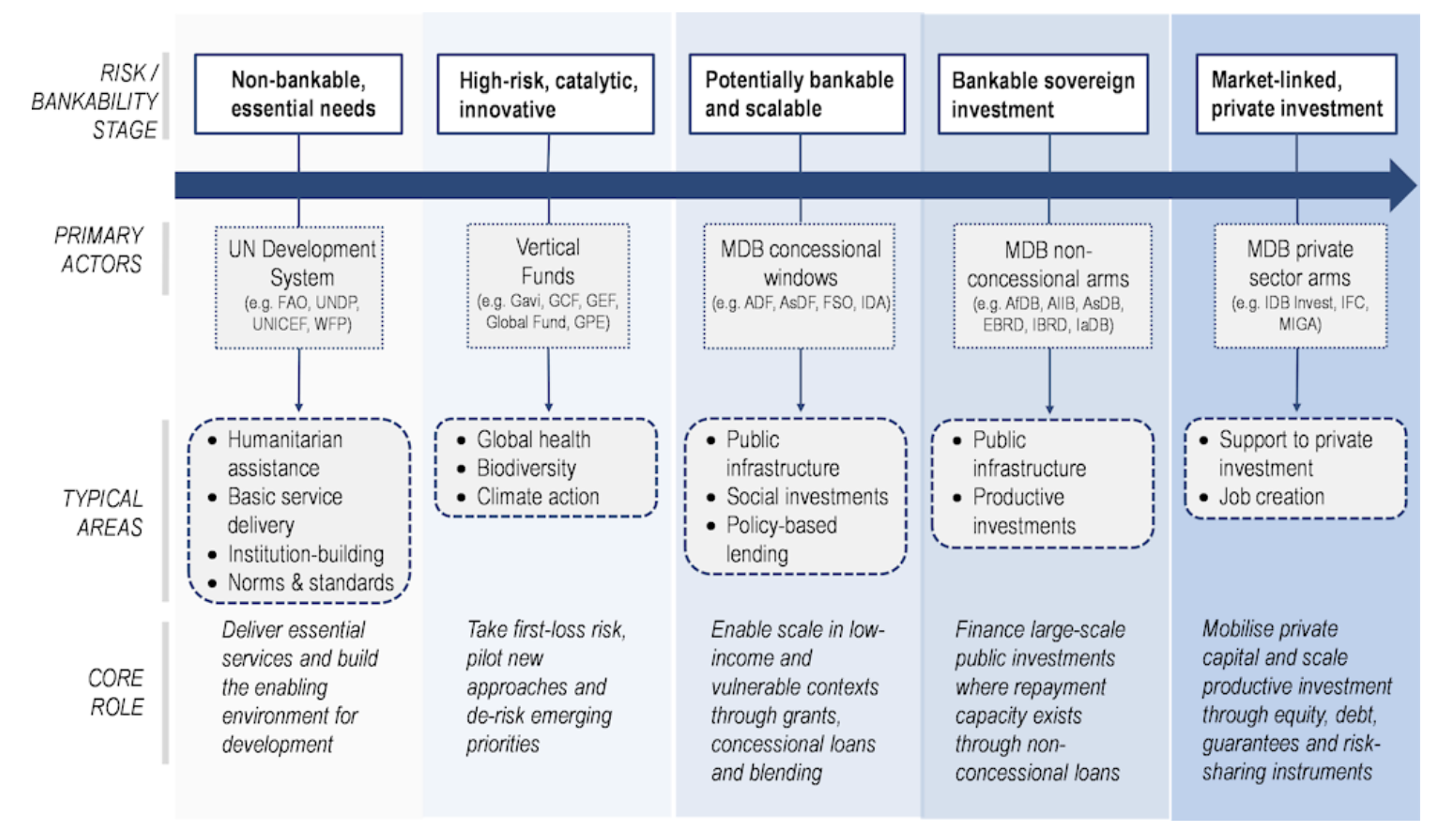
Figure 1: Horses for courses: Different types of development finance for different contexts (reproduced from Multilateral Development Finance, OECD, 2026).
As partners are scoping out so-called innovative financing instruments to fill the financing gap left by retreating donors and fiscally challenged governments, different modalities are being discussed (see Fig 1 for a Multilateral Development Bank (MDB) financing typology by type and purpose), from debt to health swaps, systematically explored under Brazil’s G20 Presidency, to, more recently, ways of leveraging development banks’ balance sheets to finance critical health system functions such as procuring essential commodities, as in the case of African Development Bank (AfDB)’s Africa Medicines and Equipment Facility, and the Africa Health Sovereignty Fund, discussed during the recent World Health Summit (WHS) in Nairobi with United Nations Capital Development Fund (UNCDF) and Africa Centres for Disease Control and Prevention (CDC) amongst other partners.
In an attempt to more systematically explore the best (and worst) practices (from a Universal Health Coverage (UHC) perspective) in designing innovative financing tools, in this post we tackle issues specific to designing a blended fund (typical for public-private financing) for health systems investment, along five key steps (see Fig 2).
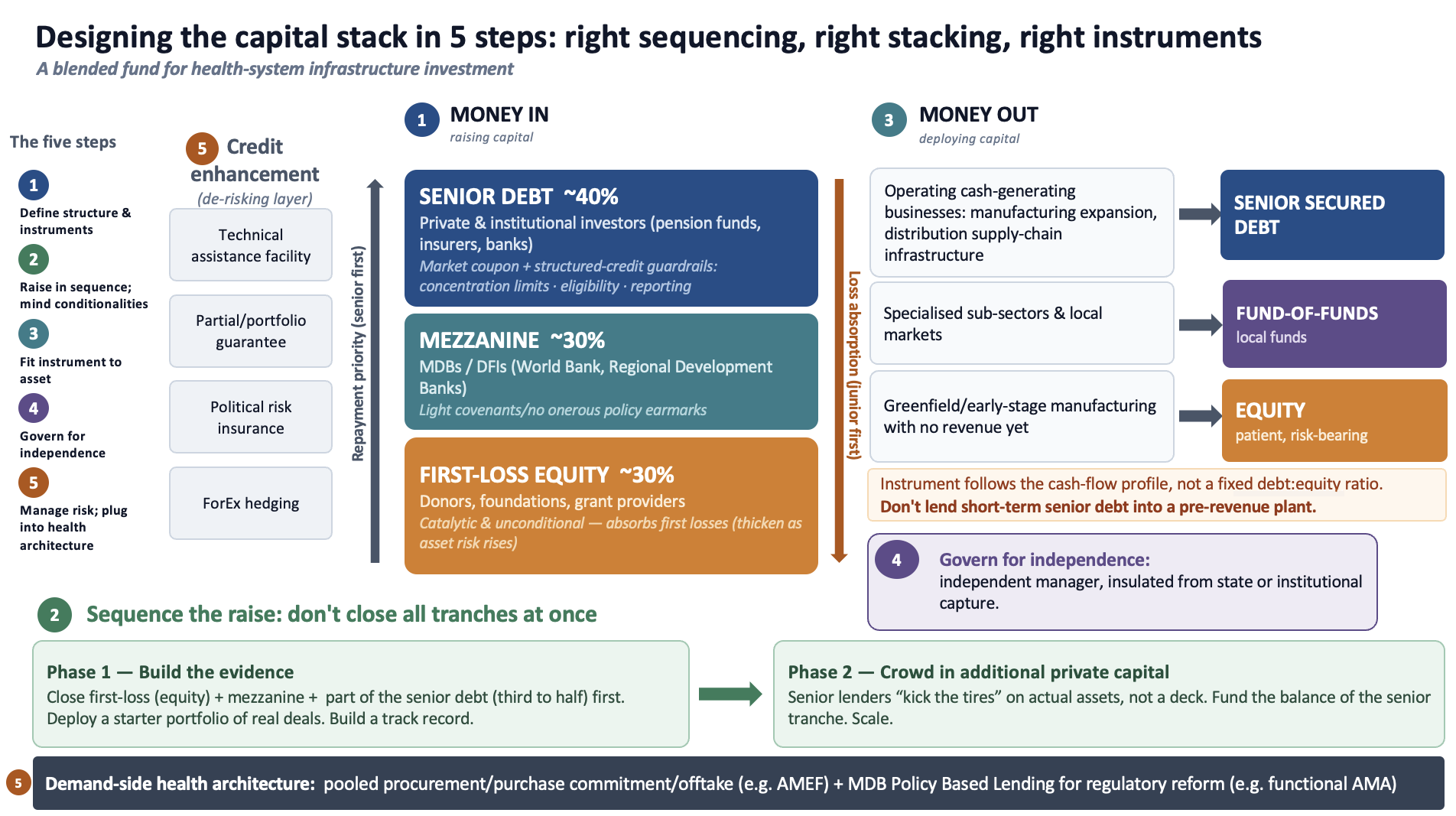
Focus: local manufacturing + supply-chain infrastructure; Percentages indicative: 2.3:1 commercial to concessional consistent with observed rates.
Figure 2: Designing the capital stack for a health system infrastructure investment in 5 steps: right sequencing, right stacking, right instruments (used Claude, Opus 4.8 based on authors’ own text).
Step 1: Define the structure (“capital stack”) and the type of instruments (equity, senior secured debt or senior debt etc) that the financing raised by the fund will be deployed in, based on potential sources and intended uses of funds
Do set your guardrails first, ideally by studying why earlier attempts failed. The financial structure should follow lessons from past failed attempts, not precede them (or repeat them) and be based on solid market intelligence.
Do keep the terminology coherent. Since one of the primary audiences is the private sector banks and investors who typically invest in structured products with multiple risk tranches of this nature, make sure the terminology is consistent with what they would routinely see.
Don’t overstretch. A modest fund with investments intended to be spread across major health system priority areas such as manufacturing, logistics, digital health, infrastructure, finance and more ends up with tickets too small to matter. Pick the few sub-streams where you can move the needle and where private capital may make sense: for a sovereign fund this is probably typically local manufacturing and the supply chains infrastructure.
Step 2: Raise money in sequence [1] and mind conditionalities
Do match financing source to the right function. Donors and foundations belong in first-loss and equity, without earmarks or conditionalities; development banks are the natural home for mezzanine tranches; private senior capital is raisable with the right coupon but only on terms it recognises (concentration limits, eligibility guardrails, clean reporting) with the understanding that expectations of open-ended flexibility on potential investments by the fund may drive lenders away.
Don’t assume more partners is better. Every extra equity or mezzanine provider condition their money with their own internal policies, compounding the cost.
Don’t try to close all tranches at the same time. Depending on the sources of private financing, the degree of de-risking built into the structure and the private lenders risk appetite, consider raising the private capital in stages. For example, start with low leverage i.e., raise a modest amount of private capital, and invest that money along with the mezzanine and equity tranches in typical investments by the fund. Look to increase leverage (raise more private capital, filling up the remaining senior tranche) once the fund has built a track record and has an asset base that private lenders can examine and evaluate. Once these structures gain market acceptance, it will be possible to start more aggressively upfront.
Step 3: Fit instrument to asset
Do match finance to purpose — long-term, return-seeking capital suits assets that generate system-wide value over time, not fragmented needs. Lending senior short-term debt into a pre-revenue plant is a cash-flow mismatch which will undermine the success chances of the deal.
Step 4: Govern for independence
Do confront the capture question: how do you stop a politically anchored fund from being steered by individual state or other institutional interests? A convener that is itself politically aligned rarely makes a credible referee.
Don’t paper over the mandate-versus-fiduciary tension. A political target and a manager’s duty to investors can pull opposite ways. Decide in advance which yields and write it down.
Step 5. Manage risk proactively and plug into global health architecture
Do source the right fund manager. Underwriting credit risk for start-up manufacturing in developing country settings is genuinely hard. Consider borrowing a development bank’s underwriting capacity, or standing up a small, dedicated team, inside a willing bilateral.
Don’t treat de-risking as an afterthought. Partial guarantees, first-loss facilities and transparent governance are prerequisites and make all the difference between a fund that closes and a concept note that circulates for years.
An important caveat
Whilst the ability to crowd in private financing using concessional funds is of critical importance, especially at times of declining concessionality rates, there are caveats given the track record of blended financing when it comes to its scale, targeting and additionality. Such concerns have triggered calls for enhanced transparency and closer alignment of blended financing with the principles and values of equitable UHC, precisely because such modalities use public monies (whether via Multilateral Development Banks (MDBs) or Development Finance Institutions (DFIs)) to subsidise private investment (also known as “derisking”).
In fact, no country has made any serious progress towards UHC with private financing alone: private (as well as donor) monies can only complement and catalyse (at best; at worst they can distract, fragment, de-equalise and crowd out) domestic public funding for health.
As the financing for health ecosystem is changing fast, World Health Organization (WHO), under our renewed mandate[2] in this space, will, working with our partners, intensify our efforts to offer countries health financing intelligence, practical tools and guidance and norms on all types of financing for UHC, because the quality of funding oftentimes is as, if not more, important than its quantity and “filling financing gaps” can do more harm than good.
 Kalipso Chalkidou, MD, PhD, directs Health System Performance, Financing and Delivery at WHO. She founded the Global Fund’s health finance department and National Institute for Health and Care Excellence (NICE) International, was Global Health Policy Director and Senior Fellow at Center for Global Development (CGD), and is a Visiting Professor at Imperial, working on evidence-informed priority-setting for equitable UHC.
Learn more about Kalipso Chalkidou on LinkedIn
 Rahul Singhal is a consultant advising the Performance, Finance and Delivery Department on private financing for health systems. He joined WHO in July 2016. Prior to that, was with the Global Fund as Chief Risk Officer and Head of Programmatic Monitoring and Risk Division. Started career with Bank of America and was there for almost 3 decades spanning Corporate & Investment Banking, Market and Counterparty Risk Management, and Corporate Treasury across Asia, Europe, and the USA with expertise in structured products, global markets and capital markets, and risk management.
Learn more about Rahul Singhal on LinkedIn
Check our Glossary for definitions of the technical terms, abbreviations and acronyms mentioned in this blog post.
[1] Sequencing the raise: Under the proposal, while the entire senior tranche may not come in upfront, all parties to the transaction will agree on the expected total size of the senior tranche/fund. Establishing a track record does not require all the funds to be invested and will take say 6 months on a 5 year structure. This period could be reduced further by underwriting the credits before the fund is launched thereby protecting the leveraged returns for the mezzanine and equity tranches. Also, once a deal like this is agreed, it will be highly unusual for senior lenders not to take up the remaining tranche albeit with some adjustments to the underwriting standards.
[2] See the Economics of Health for All Resolution (2024) and Strategy (2026) and the Strengthening Health Financing Globally Resolution (2025).